To keep pace with inflation and cover cost-of-living increases for teachers and staff, Canyons School District is proposing an increase in the certified rate for the 2026-2027 school year.
The public is invited to learn more and provide input at a 6 p.m. Truth-in-Taxation hearing on Tuesday, Aug. 4 in the Canyons Board of Education Chambers, 9361 S. 300 East, Sandy.
To ensure all patrons are able to participate in the hearing, the meeting will be broadcast live on CSDtv: https://www.canyonsdistrict.org/board-meeting-livestream/. Canyons District parents, property owners, and employees may participate virtually, in writing, or in person at any time during the public-input portion of the hearing.
Participating in Person
Patrons wishing to provide public comment in person are asked to write their names on the provided sign-up sheet at least 15 minutes before the published start time of the meeting. Patrons who arrive later will still be allowed to speak and the public comment roster will be updated throughout the duration of the public comment period. Each patron will be provided two minutes to speak.
Participating Remotely
Community members may send input in writing before or at any time during the public comment portion of the meeting by sending an email to communications@canyonsdistrict.org. Written comments must be accompanied by the sender’s name and address, and there is a 450-word limit. These comments will be read aloud during the hearing and kept as part of the official record. Patrons wishing to provide public comment virtually are invited to join the meeting via Zoom:https://canyonsdistrict-org.zoom.us/meeting/register/x6vdJ5d2Rva7tSR73cjbtg. When they log on, they will be greeted and asked to provide their name and contact information and will be invited to give audio or video remarks in the order they enter the queue.
Frequently Asked Questions
How would the money be used?
Property taxes levied for District operations are used to help pay for salaries and benefits of District employees, including teachers, principals, paraprofessionals, custodians, and others who provide instructional and other support services in schools. The proposed tax increase would yield:
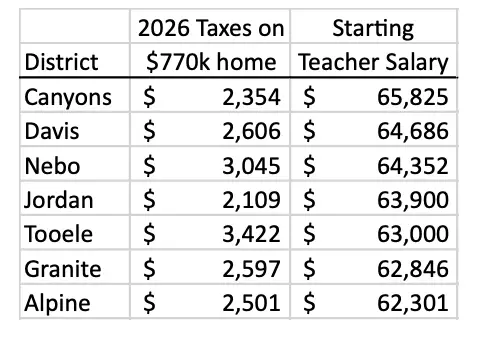
- $2.2 million in General Fund revenue to offset inflationary increases and reductions in state funding, which are putting a squeeze on fixed education budgets. Through Canyons District’s negotiations with employees, teachers are receiving a 1.10 percent cost-of-living increase, along with 0.40 percent from the state, for a total of 1.50 percent. Education Support Professionals (ESP) and Administrators will each receive a 1.50 percent cost-of-living increase. The proposed tax adjustment would bring the cost-of-living increase for all employees to 2.25 percent. While this cost-of-living increase does not fully match the 2.8 percent inflationary increase for 2025-2026, it reflects the District’s ongoing commitment to recruit and retain top talent for CSD schools while also helping to mitigate the impact of rising living expenses for employees. (See chart below detailing how starting teacher pay in Canyons compares with that of neighboring school districts.)
- As the District prepares to open its Canyons Innovation Center in August 2027, it wishes to hire two additional teachers for manufacturing and engineering. The cost for both hires will be $210,000.
- The remaining $4.5 million will be an increase in capital revenues. However, there will be a corresponding decrease in revenues in debt service (see “Canyons School Debt Svce” line on tax notices). Last year, the average homeowner paid $475 in debt service. This year, with the proposed change, the average homeowner would pay $429, or $46 less. It should be noted that without this shift from the debt service to capital revenues, the average homeowner would still pay $475 for debt service this year. With the proposed change, the $4.5 million would still be used to pay general obligation debt and would not be used for any capital projects. The District will be able to retire much of its debt in the next few years and wishes to start rebuilding or renovating some its aging elementary schools without increasing the tax burden on property owners. This would be accomplished by changing how some property tax money is labeled and used — from “debt” to “capital” — without an increase in tax payments for property owners. This proposal would shift some tax revenue from the Debt bucket into the Capital bucket to pay off debt, and as debt is retired, fund elementary school improvement projects on a tax-neutral basis. While Canyons has focused on rebuilding or renovating its middle and high schools, it currently has 13 elementary school buildings that are more than 50 years old and in need of upgrades. Canyons’ goal is to accomplish these upgrades on a tax-neutral basis.
Don’t property taxes already keep pace with inflation?
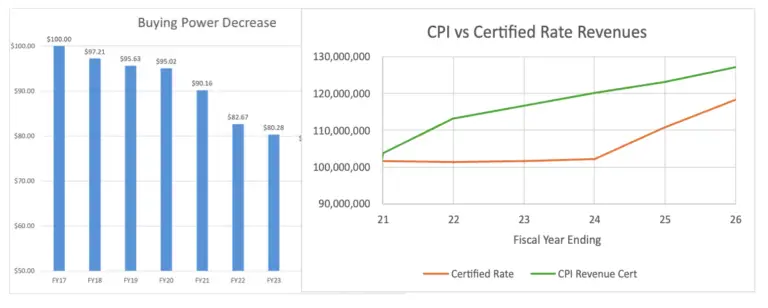
No. In Utah, property tax rates are automatically adjusted to compensate for swings in property values. This adjusted tax rate is called the certified tax rate. As property values rise, the certified rate falls so as to keep neutral the amount of revenue generated from year to year. This system, as designed by the state Legislature in 1985, allows local governments and school districts to draw the same amount of revenue as budgeted the previous year. However, the certified tax rate does not capture inflation. For this reason, taxpayer advocacy groups have endorsed the practice of taxing entities issuing modest tax increases to recoup recurring inflationary losses. This is done through Utah’s Truth-in-Taxation process. Even with the proposed rate increase, CSD’s property tax revenue would not match the pace of inflation, or the Consumer Price Index (CPI). See chart below (source: Bureau of Labor Statistics, Historical Consumer Price Index for All Urban Consumers).
How will this impact my taxes?
The exact amount for each home is shown on the property tax notices mailed by the Salt Lake County Auditor in July. The annual tax increase for the average home in Canyons District, valued at $770,000, would be an estimated $72 (see Canyons School District line on tax notice). However, the amount owed for the debt will decrease by $45 (see Canyons School Debt Svce line) for a net increase of $27, or $2.25 per month.
What do the lines “State Basic School Levy” and “Canyons Charter School” mean on my property tax notice?
Utah’s main education funding formula requires the Legislature to set a “basic rate” that is charged equally to each property owner statewide. Canyons School District does not have any control over this rate. This year the rate is 0.001351 for each dollar of taxable value. If your home increased 2 percent or less in value from 2025, the amount owed will be about the same or a little less. However, if your home increased in value by more than 2 percent the amount owed for this line will be more.
A decade ago, the state began listing a charter levy on tax notices as charter schools are also public schools. The state determines this levy based on a formula that accounts for students attending charter schools and the district’s assessed values.
Why did my taxes go up more or less than the state average increase?
Generally, when property values grow, property tax rates decline to maintain revenue neutrality. Even with this built-in ceiling effect, some property owners might have a higher property tax bill while others see a decrease. This is because the tax rate is based on average home valuations. If your home was recently assessed or your valuation rose at an above-average rate, you would see an increased payment. If your home valuation was below-average, you may pay less. Home values have increased at a much higher rate than commercial buildings, which can push more of the tax impact to homeowners. Homeowners, however, receive a 45 percent exemption on their home value while commercial properties do not.
What relief is available for homeowners on fixed incomes?
We appreciate some of our patrons who are living on fixed incomes struggle to afford even modest property tax increases. The Utah Legislature has created seven different relief programs for qualifying low-income, elderly, and disabled homeowners. Information for tax relief and referral programs can be found on Salt Lake County’s website. The deadline for applying for these relief programs is Sept. 1, 2026.
Some homeowners may feel the value of their property is overstated by the Salt Lake County Assessor’s Office. If you feel this is the case, you may consider appealing to the Board of Equalization by Sept. 15, 2026. Information can be found on the Salt Lake County Auditor’s website.
Patrons may also wish to review the 2026-2027 Canyons Tax Impact Statement, the Notice of Proposed Tax Increase, and the Salt Lake County Notice of Propoased Tax Increases. All can be found at the top of the District’s home page, https://www.canyonsdistrict.org/.
The chart below shows the total taxes paid to schools for a $770,000 home, which is the average cost of a home in Canyons School District, and the starting teacher salary for several school districts along the Wastach front.