As the clock ticks toward the start of Super Bowl XL, the banter among football fans is focusing on the much-anticipated battle between the Seahawks and Patriots.
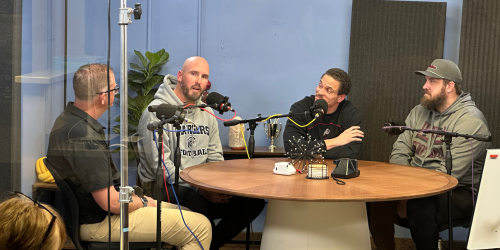
While Vegas oddsmakers are giving Seattle the edge, check out the new Connect Canyons for the predictions of Canyons District’s resident gridiron experts. And while listening to our third-annual Super Bowl predictions podcast, you also might pick up some insider’s insight that could impress even the most ardent football fans at the party on Sunday.
On this week’s episode, Superintendent Dr. Rick Robins, a Southern Utah University Hall of Famer for his four-year stretch as the T-Birds’ quarterback, was joined by two Canyons head football coaches and a CSD educator who was a standout defensive back for the University of Utah. Former NFL standout Sealver Siliga, who suited up for both Seattle and New England during this career, also contributed to the conversation.
“I know for me personally with my own family, my own son, just how important football is,” says Robins, whose son, Nick, is the head coach of the Mountain Ridge Sentinels, which made it to the 6A semifinal game at Rice-Eccles Stadium in the 2025 season.
“It has really done so much for my life on a personal and professional level, as it has for my family,” Robins said. “And I know that’s impacted all of you, and I think about just the great coaches and mentors and people that have been in our lives and what it means to the school and to the cultures that you all impact.”
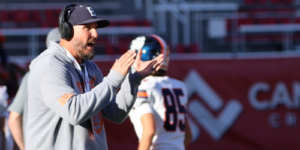
The two coaches featured on the episode — Corner Canyon’s Casey Sutera and Jordan’s Marc Albertson — reflected on the influence of coaches and mentors at all levels of the sport, from youth leagues to the professional ranks. They shared how early encouragement and structured expectations helped shape their approach to leadership, accountability, and teamwork — both on and off the field.
For his part, Siliga, said the educators who influenced his teenage and young-adult years helped guide his path through college and into the NFL.
The Super Bowl champion also gave a special shout out to CSD Student Engagement Coordinator Charisse Hilton, who met Siliga as a high school administrator. “Without Miss Hilton,” he said, “I could have went the wrong way and went down a path that didn’t lead me to the University of Utah” where he appeared in 37 games over a three-year period.
Today’s students need role models and mentors to navigate life’s challenges, he said. “What you guys are doing is so impactful,” Siliga said to educators Sutera, Albertson and former Ute and current Peruvian Park teacher Cal Beck. “
“When you’re at that age as a kid, you really don’t see past the present day,” he said. “And for somebody to see and believe in something that you don’t, you can’t even comprehend (that it) is such a blessing.”
Conversation on the podcast also highlighted the parallels between coaching and teaching. Preparation, repetition and review — whether in practice or the classroom — help students build confidence and resilience. Learning to accept feedback and recover from setbacks, the panelists said, is a skill that extends well beyond athletics.
“Football, specifically, it does mirror a lot of life lessons and qualities. When kids figure out that independently and as a cohort team, it just gives them more of a boost,” Beck says. “It’s a springboard into success for the rest of your life. The winning that happens on the football field isn’t always on the scoreboard. Just like it, in any sport, if you can start at square one and grow and you can show these kids, this is what matters.”
The football season also tends to set the tone for a school year. Friday Night Lights creates a sense of unity. It’s a moment in time when an entire community, from cheerleaders to the marching band to alumni to boosters, can be found cheering for the home team.
As for Sunday’s game, while predictions (and picks for favorite party snacks) varied, the panel agreed that preparation and trust — developed well before kickoff — remain central to success at every level of football.
“I always tell my boys — look around and you’ll see the people who are working and lifting in school, and those are the people you’re going to trust when it comes to those hard moments,” Albertson says. “I think that is what makes football so awesome and that’s what makes the football community so awesome.”
The Connect Canyons conversation underscored a broader message echoed throughout the discussion: while wins and losses matter, the lasting impact of football is often found in the lessons learned, the relationships built, and the confidence students carry with them long after the final whistle.
“I know our young people are going through a lot,” Robins says. “Everything that’s happening in our world and all the pressures and mental health issues and things that our students are dealing with, I hope that they listen to you and listen to our podcast today and can just gain a little bit of hope.”