Walk into a classroom almost anywhere in America and — but for some exceptions — you will see a familiar scene: desks in rows and students sitting face-forward, learning largely the way their grandparents did. Outside those classroom walls, however, the world those students are preparing to enter has fundamentally changed.
America is re-onshoring industries and rediscovering the dignity of what it means to make things again. Artificial intelligence and automation are reshaping how work gets done. At the same time, the industries defining the next century of American competitiveness — advanced manufacturing, aerospace, defense, robotics, energy, cybersecurity, and engineering — face a talent pipeline crisis.
The country is at a reckoning point, one that requires public education to evolve to start preparing students as early as high school for immediate entry into these high-wage, high-demand careers, said Canyons District Superintendent Dr. Rick Robins. “Academic achievement is always going to be at the heart of what we do. But we really do need to lean into this philosophy of workforce readiness.”
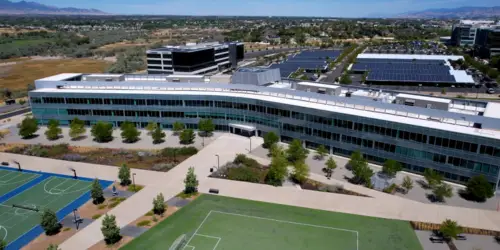
That is the premise behind the Canyons Innovation Center, a profession-based learning center coming in August 2027 to the former regional headquarters of eBay in Draper. The facility is not a school in the traditional sense. It is an R&D-inspired environment where students work with professionals to solve real-world business problems while earning college credit and industry certifications, and developing the work habits and skills that employers say they so desperately need.
The inflection point: why this moment demands a new model
In a recent episode of the Connect Canyons podcast, Dr. Robins joined Reid Newey, Director of the Innovation Center, and Aaron Starks, CEO and President of 47G, an organization working to make Utah a national leader in aerospace and defense. The trio discussed how the Innovation Center represents more than a new school, but a strategic response to a national need.
Done right, said Robins, and it could be “a game changer…that sets the stage to reimagine what education, especially public education, can be.”
Starks, a globally experienced workforce strategist, describes the current moment as unusually challenging. “We’re having a moment now that we can’t actually read about. We can’t go back and look at history to learn about how to handle the present or even how to prepare for the future,” he said.
On one hand, today’s students are more technologically fluent than any generation before them. On the other, employers increasingly report that many entry-level candidates struggle with interpersonal skills—communication, grit, and teamwork—the human capabilities that AI cannot replace.
“AI will never replace a human’s ability to lead people, to communicate effectively, to set goals, to manage an organization,” Starks said. “Thousands of employers are struggling to hire talent that can lead teams.”
Meanwhile, the United States is navigating the consequences of decades of outsourcing manufacturing at a time when geopolitics has made domestic production an urgent economic and national-defense priority. The aerospace and defense industry alone is a trillion-dollar sector nationally and represents 20 percent of Utah’s GDP annually, notes Starks, and it’s not purely digital. It is the integration of hardware, software, and firmware, which means building physical systems, operating them, and securing them.
For students, that reality creates both disruption and opportunity.
Canyons Innovation Center Director Reid Newey notes, careers are evolving rapidly, and many of the jobs students will one day pursue have not yet been invented. But that is precisely why education must avoid training for narrow tasks, and instead, equip students with adaptable skills and professional fluency.
“We can’t compartmentalize,” Newey said, referring to instilling within students the everyday habits they need to succeed in any arena. “We’ve got to bring all of that together. And that’s what we intend to do at the center. We want to have a great welding program, but we also want to develop an entrepreneurial spirit in every one of our welders…so they can be moldable to any industry that comes along in terms of applying their welding skill.”
A building designed to change the mindset of learning
Repurposing a former global tech headquarters to serve as the home of the Canyons Innovation Center is not merely a pragmatic real estate decision; it is a signal to students that what happens inside is different.
Located in the heart of Silicon Slopes, Utah’s tech sector, and adjacent The Point Innovation Community, the center is strategically positioned—both physically and conceptually—within a broader ecosystem that includes higher education and some of the state’s most dynamic economic sectors, Newey said. But the most important design choice may be philosophical: the Innovation Center is being built around profession-based learning, or experiences that mirror the expectations of adult workplaces, not the rhythms of traditional school.
Teachers act more like project managers than lecturers. Students work on authentic projects that come from local employers, not from textbooks, demonstrating competencies and developing portfolios that reflect what they can actually do.
This shift matters, said Newey, because “many larger companies have moved from a knowledge-based hiring platform to a skills-based hiring platform.”
As Robins described it, the Center will create “collision points”—moments when students regularly intersect across disciplines. A digital media student might create marketing content for an engineering firm and engineering student might create a prototype for the aviation and drone program.
The partnership model: closing the distance between classrooms and the workplace
The facility itself is being developed with significant, and early, input from industry partners.
“Our vision is to start with the most immediate thing: design the physical space so that we can accomplish a true profession-based learning environment,” Newey said. “We’ve done that by consulting our professionals.”
Employers specified the needed equipment for each program so that the pharmacy tech program or crime lab operate like the settings students will encounter in the field.
The tools students use will be integrated into daily instruction, not set aside for occasional demonstrations, Newey explained. In medical programs, for example, students will use electronic health systems while working through patient scenarios, rather than learning the software separately from clinical practice.
But these partnerships extend beyond space. Industry participation involves advising on curriculum and mentoring students through hands-on projects that allow students to practice writing, presenting, working together, managing deadlines, and finding solutions to problems that matter to real organizations. Nearly 90 percent of the center’s teaching staff will come directly from industry who teach the way they learned: by doing the work.
This is powerful, because as Starks noted, in a world where students often struggle to connect schoolwork to their future, professional context changes motivation.
“If an industry leader came and said, ‘Over the next six weeks, you’re going to be participating in a project to enhance skills—and these are the skills I need to hire,’ they listen a bit differently,” Starks said.
A challenge to industry: workforce development is your job
Embedding industry in education takes relationship-building. But as Starks noted, this should be a priority for employers. Too often, he argued, workforce development is treated as someone else’s problem, or something to be addressed by the government or education alone.
He disagrees and asks a simple question of CEOs who complain about the shortage of talent: “How many students have you taken to lunch this past quarter?”
For Starks, that question is not rhetorical. While working on his MBA at Duke University, he always knew when McKinsey and Bain, or BCG Consulting Group were on campus, because they emailed him with an invitation for lunch.
“I sat down, learned from them about their company. They looked me in the eye. I felt like they had an interest in me,” he said. “And when I left that lunch, I was connected on LinkedIn to an executive. Now, the probability of me going to work for a company who’s done that for me? Astronomically higher.”
If Utah wants to lead in high-growth industries, companies cannot start at the end of the workforce pipeline and criticize the supply, Starks said.
That is the part 47G would like to play at the Innovation Center, bringing industry closer to schools and students, and helping to create structured opportunities for mentorship and exposure, which could come in the form of a speaker series, Starks said. “Our goal is to help you staff it with CEOs and executives from companies who can come spend time with students.”
Embedding trades, tech, entrepreneurship, and creativity into the K-12 experience
While aerospace and defense featured prominently in the discussion, the Innovation Center will also address equally urgent workforce needs, from healthcare and construction to hospitality and skilled trades.
What’s more, said Robins, it’s meant to serve as an anchor point— and end-of-system “lighthouse” to inspire a new kind of learning across the District, from kindergarten through the 12th grade, and beyond.
“If you really study educational models…one of the most successful models is backward mapping,” he said. “Looking at the future first, then mapping back all the skills you need to get to that point.”
Toward that goal, Utah’ STEM Action Center will have a footprint at the center, which will expose students to STEM and industry connections, hands-on learning, and the power of creativity in elementary and middle school. Higher education institutions will also have a seat at the table — quite literally in some cases, as in the example of the chef at Salt Lake Community College who has consulted on the Innovation Center’s culinary program.
Measuring success: not just jobs, but creators
For students, the message is that not everyone must pursue one industry. The world is changing quickly, and Canyons District, working with industry and higher education, is creating opportunities for students to participate in that future, rather than watching it happen to them.
Every new model needs a way to measure impact. For Canyons, success will include traditional course completion, certifications, early college credit, and employment — but also innovation.
As Starks stressed, one important way to measure success is “how many student take ideas…and go create their own companies?” That implies teaching students how to pitch ideas, connect with investors, and sustain relationships after graduation.
Robins also emphasized the importance of a strong alumni network of graduates returning to mentor, recruit, and invest in the students who are coming behind them.
The Canyons Innovation Center is a bet on students, that they can do hard things, that they can lead, and that public education can be a powerful engine, not only of learning but of regional innovation and economic competitiveness.
Newey’s perspective, informed by years of watching students rise to expectations: Students do not lack potential, they sometimes lack opportunity. “I’ve never seen a student shrink from that opportunity when you surround them…with support and great tools,” he said.
Learning at the Canyons Innovation Center
The Innovation Center will serve approximately 3,650 students annually, or 32 percent of the Canyons District’s high school students, across eight program clusters: Business/Entrepreneurship, Integrated Media, Information Technology, Emergency Services, Medical Services, Skilled Trades, Engineering/Manufacturing/Aviation, and Hospitality/Culinary. Fifteen existing Canyons Technical Education Center (CTEC) programs will relocate to the new facility. Seven new programs will fill industry gaps in current offerings: Artificial Intelligence, AR/VR, Culinary, Drone Aviation, Engineering, Machining, and Video Production.